Researchers uncover dark web operations paying users for genuine biometric data.
WASHINGTON, DC.
Biometrics were supposed to end the password era. No more memorizing, no more resetting, no more sticky notes under keyboards. Just a face, a blink, and you’re in.
In 2026, criminals are treating that promise like a business opportunity.
Across fraud forums and underground marketplaces, investigators are tracking a fast-growing tactic that looks less like traditional hacking and more like a supply chain: “facial ID farms,” operations that recruit, rent, or buy real people’s biometric submissions at scale, then use AI to repackage those signals into account takeovers, fake onboarding, and payment fraud. In plain terms, instead of trying to break biometric security, they try to purchase it, either by paying someone to complete verification tasks or by harvesting the real biometric data needed to make a synthetic identity look “alive.”
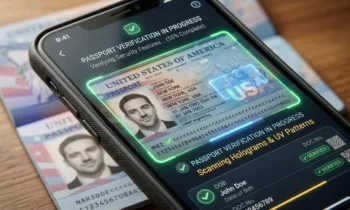
It matters because the world has quietly adopted selfie-based verification as a default gatekeeper. Banks, crypto platforms, gig economy apps, travel services, and even some HR onboarding flows now rely on face matching and liveness checks as proof of personhood. That makes biometrics a high-value asset, and it creates a brutal incentive: if you can industrialize the capture of genuine faces and genuine liveness signals, you can industrialize the fraud that comes after.
Key takeaways
• Biometric checks are being targeted through “human supply” tactics, not just technical exploits.
• The most valuable commodity is not a deepfake; it is a real person’s face data tied to a real identity.
• Businesses that treat facial biometrics as a single strong factor are building a single point of failure.
• Consumers can cut risk by reducing where their face data is stored and strengthening account recovery controls.
What a “facial ID farm” actually is
The phrase can sound like science fiction. The reality is closer to a remote work scam.
A facial ID farm is typically a network that produces biometric verification attempts on demand. Sometimes the participants know what they are doing and are paid for it. Sometimes they are tricked into “testing” an app, “verifying” an account for a job, or “helping” a friend with a sign-up. Sometimes they are coerced, especially in scams that combine identity theft with financial pressure. And in many cases, the operation is not collecting biometric data in the abstract. It is collecting a successful biometric event, a completed selfie video, a passed liveness check, and a face match that clears a platform’s automated gate.
If you are a fraud ring, that is gold. The moment a platform marks an identity as “verified,” downstream defenses often soften. Limits go up. Transfers become easier. Support agents assume legitimacy. Risk engines treat the account as lower friction. The farm does not need to defeat every biometric system. It only needs enough successes to keep the pipeline flowing.
Why do criminals pay for genuine biometrics instead of faking them
AI deepfakes get headlines. The bigger story is economic.
Deepfakes can be impressive, but they are not always cheap, stable, or reliable across verification apps. Many onboarding flows now include motion prompts, lighting checks, texture analysis, and device-level signals intended to detect spoofing. The arms race is real, and it is pushing criminals toward a simpler approach: use real humans.
A recent report on enterprise anxiety around deepfakes and “injection” attacks notes that organizations are increasingly hesitant to rely solely on facial biometrics, in part because adversaries are scaling techniques to undermine liveness. The concern is not limited to fake faces. It extends to the integrity of the entire capture process, the camera feed, the device, and the session itself. That report is here: Deepfake detection confidence is wavering, and more firms are pairing facial checks with other controls.
The business logic for criminals is straightforward.
Real faces pass more often than synthetic ones. A real person can follow prompts naturally. A real person can handle unexpected UI changes. A real person can provide multiple angles, expressions, and timing patterns that make live systems more confident. When you can recruit thousands of people across time zones, you can turn a biometric check into a gig task.
This is why “biometric mule” recruitment is becoming a category. It is the same playbook used in money mule networks, applied earlier in the funnel. Instead of paying someone to move funds, you pay someone to open the door.
Where the biometric pipeline breaks, and why it keeps breaking
Most biometric security failures in the consumer world are not Hollywood-style mask attacks. They are workflow attacks that exploit assumptions.
Assumption 1: The camera feed is trustworthy
Many verification systems assume the image stream reflects a live camera and a live person. If the device is compromised, remotely controlled, or using a manipulated input, that assumption can fail. Even when platforms add checks, adversaries keep probing for the soft spots, particularly on older devices and fringe operating system variants.
Assumption 2: Passing liveness equals legitimate intent
Liveness is a technical check. It does not measure consent, coercion, or context. A person can be alive and still be scammed into verifying something they do not understand. A person can be alive and still be completing a task for someone else.
Assumption 3: Biometrics are a “strong factor” on their own
Facial biometrics can be strong, but they are not magical. They have error rates. They can be fooled. They can be replayed. And they can be socially engineered.
This is why independent testing and measurement matter. The U.S. National Institute of Standards and Technology evaluates presentation attack detection, the liveness side of the equation, and publishes performance testing that underscores both progress and limitations across algorithms and attack types. If you want to see how the field is measured and why “liveness” is not a single solved problem, start here: NIST Face Analysis Technology Evaluation on presentation attack detection.
The dark web twist: data is not just stolen, it is produced
The older identity theft model was theft first, fraud second. A breach happens, documents leak, and fraud follows.
Facial ID farms add a third phase: production.
Instead of waiting for breaches, criminals create new “fresh” biometric events. They can generate multiple tries, multiple lighting conditions, and multiple devices. They can A B test which platforms are easier. They can build a library of successful captures and match them to identity kits bought elsewhere. And because the participants are real humans, the resulting data often looks cleaner than what is scraped from breaches.
That can lead to an unsettling outcome for victims and investigators: the biometric verification appears legitimate on paper, but it was legitimate only in a narrow sense. A live human completed it. The question becomes, who benefited, and who controlled the session.
This is where fraud investigations start to feel like labor investigations. Who recruited the “worker”? What instructions were provided? Whether coercion was involved. Whether the same IP ranges, device fingerprints, or behavioral patterns show up across many “verified” accounts. In some cases, law enforcement frames these networks as part of broader organized fraud, especially when tied to mule rings and money laundering.
A practical scenario that is playing out right now
Consider a common setup, one that does not require technical wizardry.
A person is offered a remote “account verification” job. The pay is small but immediate. They are told a company needs help testing sign-up flows in different regions. The instructions are simple: download an app, take a selfie video, follow a few prompts, then forward a confirmation screen.
They are not told the account is for a financial platform. They are not told that the identity data belongs to someone else. They are not told that the verification is the last gate before a credit line is issued or before a wallet is allowed to receive funds.
If the platform treats facial verification as the decisive step, the fraud ring wins.
And if the platform treats “verified” as “safe,” the ring wins again.
Why consumers should care, even if they never use facial ID
Many people think, “I do not use face unlock, so this is not my problem.”
But facial data is collected far beyond your phone lock screen. It is collected during account recovery. It is collected during onboarding for services you might only use once. It is collected when you travel, rent, apply, or register. If your identity documents have ever been photographed, uploaded, or stored by third parties, your exposure is wider than you think. And when the fraud ecosystem can buy, trade, or produce the biometric component, traditional advice like “change your password” starts to feel incomplete.
A password can be reset. A face cannot.
That is why the most important consumer protection step is not “get better at selfies.” It is to reduce how often your face becomes a credential in the first place, and to harden the non-biometric controls that surround it, email security, phone number security, and account recovery.
What companies should be doing, and why many are behind
If you run a platform that uses facial biometrics, the uncomfortable truth is this: your security depends on what you do after the face match, not just on whether it succeeds.
Strong programs are moving toward layered verification, where a biometric pass is necessary but not sufficient. They combine it with device integrity signals, anomaly detection, behavioral patterns, velocity limits, and step-up checks for risky actions. They also assume that some percentage of biometric events are not what they appear to be, even if they are technically “live.”
They also rethink what “success” means. If you only measure false accepts and false rejects, you miss the larger fraud question: how many verified accounts later become vehicles for scam payments, laundering, or chargeback abuse.
AMICUS INTERNATIONAL CONSULTING, which advises clients on compliance-focused identity risk, cross-border exposure, and the operational reality of biometric screening in travel and finance, has emphasized a simple principle: biometrics reduce some kinds of fraud, but they also concentrate risk when organizations treat them as a single, decisive proof of legitimacy. That risk is increasingly visible in modern onboarding and account recovery workflows. A primer on the broader biometric risk landscape is available here: Amicus International Consulting analysis on biometric technology and its impacts.
What you can do today, without becoming paranoid
You do not need to stop using modern services. You do need to stop treating biometric requests as harmless.
Here are practical steps that reduce real risk.
- Lock down the two assets criminals use to take control after verification
Protect your email and your phone number. Use strong multi-factor authentication on your primary email. Ask your mobile carrier about port protections and account locks. Many fraud chains still hinge on taking over email or SIM, even when biometrics are involved. - Be skeptical of “verification tasks” and “test jobs.”
If anyone asks you to complete a facial verification “for work,” “for testing,” or “to help open an account,” treat it as a red flag. Legitimate employers do not pay random people to complete identity checks for unknown platforms. - Reduce where your face data is stored
Do not upload selfies and ID photos to services that cannot explain retention. Avoid sending biometric images over casual messaging channels. If a vendor insists on keeping a copy indefinitely, weigh whether the service is worth it. - Use app-based authentication and recovery options that do not rely on images
Where possible, choose recovery methods that are not “send us a selfie.” The more your recovery depends on your face, the more your face becomes a target. - Watch for subtle account changes
Fraudsters often change contact emails, recovery numbers, or notification settings before they steal funds. Turn on alerts. Review security settings periodically. Treat unexplained “verification complete” emails as urgent.
The bottom line
Biometric security is not collapsing. It is being adapted, and adversaries are adapting faster in the places where businesses expected the camera to do the hard work.
Facial ID farms are a warning sign that the next era of fraud will not be defined only by code. It will be defined by incentives, recruitment, coercion, and the monetization of human signals, including your face, liveness, and the credibility of your identity.
If you are building security systems, the lesson is clear. Do not treat facial biometrics as a standalone gate. Bind it to context, layer it with other checks, and assume criminals will try to buy what they cannot reliably fake.
If you are a consumer, the lesson is even simpler. Your face is becoming a credential. Treat it like one.