In commercial and industrial construction, choosing the right decking material is a decision that affects nearly every aspect of a project. From structural performance to cost and code compliance, the materials used to support floors and roofs must meet the demands of scale, efficiency, and longevity. Among the top contenders for large-scale builds are wood, concrete, and steel decking. While each has its place in the construction world, not all are equally suited for demanding, high-capacity environments like warehouses, schools, hospitals, high-rises, and industrial facilities.
Today, many architects and engineers are increasingly turning to steel decking for its strength, speed of installation, and overall performance. But to understand how it stacks up, it’s important to compare all three options across the most critical considerations in large-scale construction.
Comparing Structural Strength and Span Capabilities
In large buildings, materials are expected to perform across longer spans without compromising safety or stability. Wood decking, especially traditional lumber, is often limited in this regard. It typically requires frequent supports and may suffer from deflection or warping, especially under heavy loads or in changing humidity. Even engineered wood products like cross-laminated timber offer improvements, but they are not ideal for very large commercial or industrial settings.
Concrete is a much stronger material in terms of compression and can handle heavy loads. Precast concrete planks can span long distances and are commonly used in parking garages and mid-rise office buildings. However, concrete’s substantial weight adds to the load on columns and foundations, which can increase costs and design complexity.
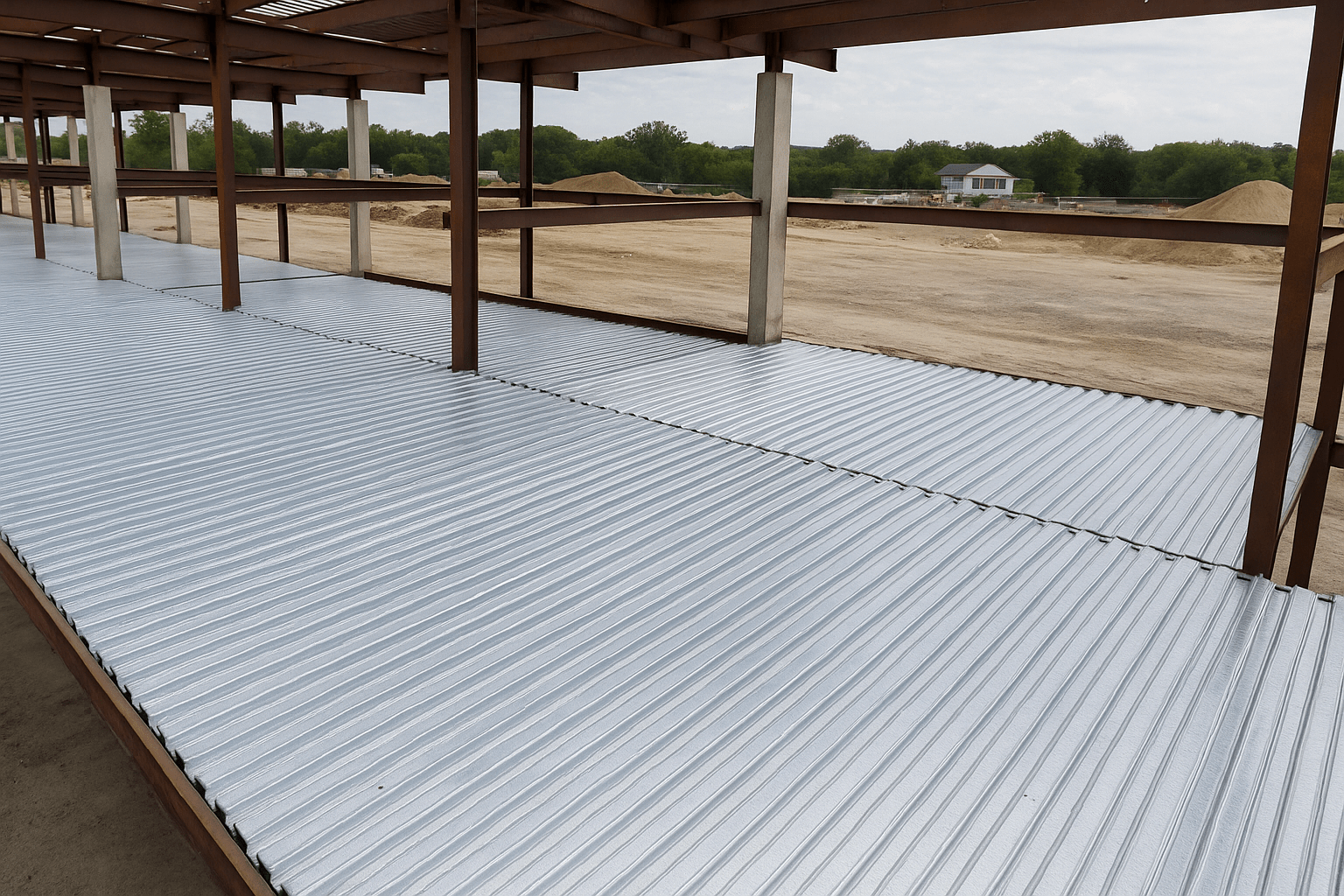
Steel decking offers the best balance of span capacity and weight. Its high strength-to-weight ratio means fewer support beams are needed, resulting in more open space and flexible interior layouts. This is especially valuable in distribution centers, manufacturing plants, and large event venues where unobstructed floor areas are critical. Additionally, steel decking can act as both a structural surface and a permanent formwork, making it an efficient choice for both roofs and floors.
Evaluating Speed and Ease of Installation
Time is often one of the most valuable resources on a commercial construction project. Delays not only affect labor costs but can also push back leasing, occupancy, and revenue timelines. Installation speed is an area where steel decking stands out clearly.
Wood can be fast to install on small projects, but when used on larger scales, framing and fireproofing requirements often complicate the process. Concrete takes the longest, particularly when poured on site. It requires formwork, reinforcement, curing time, and protection from weather. Even precast concrete comes with logistical challenges due to its weight and handling requirements.
Steel decking, however, is light, easy to transport, and fast to install. Crews can place and secure large sections quickly, often in coordination with the erection of the steel structure. No curing is needed, and there is little to no wet work involved. For projects on tight deadlines or in areas with seasonal weather concerns, this speed can translate into major savings.
Meeting Fire Codes and Safety Requirements
Fire resistance is a non-negotiable feature in commercial construction, especially in high-occupancy or multi-story buildings. In this category, wood falls short. While it can be treated with fire-retardant chemicals, it remains a combustible material and often triggers more complex code restrictions, especially in taller buildings.
Concrete performs very well in fire. It does not burn and provides natural fire separation between floors. However, it may spall or crack under extreme heat if not properly reinforced or protected.
Steel decking also delivers strong fire performance. It is non-combustible and often used in fire-rated floor and roof assemblies. When required, it can be paired with spray-applied fireproofing or other protective coatings to meet code-mandated resistance levels. Its predictable performance under heat makes it a preferred option for architects and engineers navigating modern safety standards.
Assessing Sustainability and Environmental Impact
Environmental impact is becoming an increasingly important consideration in building material selection. Wood is renewable and, when harvested from responsibly managed forests, can be a sustainable option. However, logging practices, transportation, and fire resistance limitations can reduce its effectiveness on very large-scale commercial projects.
Concrete has a high carbon footprint due to the cement production process. Though there are ongoing efforts to reduce emissions through supplementary cementitious materials and carbon capture technologies, they are not yet widely adopted in every market.
Steel decking offers strong sustainability credentials. Most steel used in construction is produced using recycled content, and it is fully recyclable at the end of its life cycle. Steel also supports green building certifications and aligns with circular construction principles. While the production process is energy-intensive, advances in steelmaking have significantly reduced emissions, and the material’s longevity and low maintenance add to its sustainability over time.
Considering Cost and Long-Term Value
When it comes to material cost, wood is typically the least expensive upfront. However, it can carry hidden costs related to fireproofing, maintenance, and structural limitations. Concrete may also appear cost-effective, particularly in markets where materials are locally sourced, but the labor required and the timeline for curing can drive up overall costs.
Steel decking may have a higher initial material cost in some cases, but its rapid installation, structural efficiency, and low maintenance make it more cost-effective over the long run. It reduces labor hours, supports open space design, and minimizes structural bulk. For large-scale buildings where return on investment is tied to speed and longevity, steel consistently outperforms in terms of lifecycle value.
Conclusion – Steel Decking as the Smart Choice for Large Builds
Each decking material has its strengths and appropriate use cases. Wood works well in smaller, lower-rise buildings with modest performance requirements. Concrete remains a solid choice for projects demanding thermal mass or heavy-duty floor systems. But when performance, speed, and adaptability are required at scale, steel decking offers the most well-rounded solution.
Its structural capabilities, fast install times, fire resistance, and sustainability make it a leading material in the next generation of large commercial construction. As project requirements grow more complex and expectations for safety, efficiency, and value rise, steel decking is proving to be not only a smart investment — but the material of choice for building stronger, smarter, and faster.