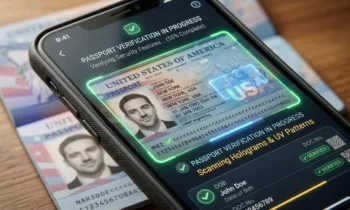
Advanced algorithms integrate CCTV and sensor data to create a comprehensive threat picture at airport checkpoints
WASHINGTON, DC. Airport security is entering a phase where the most important “screen” is no longer the X-ray monitor at the belt or the officer’s view of the line. It is the software layer sitting behind the cameras, the scanners, and the checkpoints, watching for patterns that a tired human eye can miss.
This is the promise, and the controversy, of AI-powered surveillance at airports in 2026. Modern systems can flag a weapon-like shape inside a bag image, identify an object left behind near a queue, and alert staff when behavior deviates from normal flow, often within seconds. In busy terminals, that speed matters. It is the difference between a suspicious bag being assessed quickly versus being discovered after a crowd has gathered around it.
Airports have always relied on layered security. What is changing is the integration. Video feeds, access control logs, screening lane telemetry, and baggage imaging outputs are increasingly being fused into one operational picture. That “comprehensive threat picture” is meant to help frontline staff act earlier and with more confidence, instead of relying on after-the-fact review.
The practical reality for passengers is that more of the airport is becoming a live detection environment. The operational reality for security teams is that they are being asked to respond faster, with fewer mistakes, and with clearer documentation of why an intervention happened.
The new model is simple in theory. It is difficult in practice. It hinges on whether the algorithms are accurate enough, whether the alerting is tuned to reduce false alarms, and whether the system is governed like safety-critical infrastructure rather than like a consumer tech product.
What airports are actually deploying
The term “AI-powered surveillance” covers a wide set of tools, but the most common deployments fall into two categories.
The first is object recognition in video. Cameras watch public areas and checkpoint zones. Algorithms detect objects that appear, remain static, move unexpectedly, or are left in places they should not be. This is where abandoned object detection sits.
The second is automated threat recognition in screening data. Baggage screening systems already generate detailed images. Newer software layers can classify shapes and densities more intelligently, and in some cases highlight regions of interest for the human operator. This is where concealed weapons detection shows up most often, particularly for knives and firearm components inside carry-on items.
These tools are not replacing officers. They are prioritizing attention. They are designed to say, “Look here first,” in an environment where staff have to process hundreds of people per hour.
Abandoned objects, why it is harder than it sounds
“Abandoned object detection” sounds like an obvious problem. A bag is left behind, the system alerts, an officer responds. In reality, airports are chaotic. People set bags down to tie shoes. Families reorganize strollers. Someone drops a jacket. A passenger steps away from a suitcase for ten seconds to scan a boarding pass. These moments are normal, and airports cannot afford to treat all of them like threats.
That is why modern systems use more than simple motion detection. The more advanced approaches try to establish context.
They track a person and an object together, then look for separation. They assess dwell time, how long the item has been unattended. They use “zone logic” whether the item is in a restricted lane, near a checkpoint boundary, or in a high-risk location. They can also backtrack footage to identify who last handled the item.
The goal is not to create a constant alarm machine. The goal is to create earlier awareness, and a clear chain of events, so the response can be measured rather than panicked.
In a well-run airport, this becomes a workflow improvement. In a poorly tuned system, it becomes a customer experience disaster. Too many false alarms force security teams to ignore alerts, which is the fastest way to make the technology meaningless.
Concealed weapons detection, the software layer moves upstream
Weapon detection at airports has long relied on hardware. Walk through metal detectors. Body scanners. X-ray imaging. Trained operators.
What AI changes is the software interpretation of existing signals. Instead of relying solely on a human to spot a suspicious shape in a bag image, algorithms can highlight probable weapon-like regions, classify anomalous items, and reduce the number of images that require deep manual review.
This matters because concealment strategies evolve. A prohibited item may be disassembled. Components may be spread across bags. Dense clutter can mask outlines. Operators are looking for needles in an image haystack, in an environment where fatigue is real and volume is relentless.
When AI works well, it acts like a second set of eyes that never gets tired. When it works poorly, it generates noise that slows lanes and frustrates passengers without improving safety.
The key point is that these tools are not only about detection. They are about triage. Airports want to move as many passengers as possible through the “low concern” path quickly, while pulling fewer people for deeper inspection based on higher confidence signals.
Sensor fusion, the new “brain” of checkpoint security
The most consequential change is not any single algorithm. It is integration.
A modern airport checkpoint can generate a surprising amount of data, even before AI is layered in. Lane throughput metrics. Alarm rates by device. Time stamps from credential checks. Door and access badge logs. Video feeds from multiple angles. Screening equipment status. Even environmental factors like lighting and crowd density.
When these streams are fused, the system can produce a more meaningful alert than a camera alone could. An abandoned object alert becomes more credible if it appears in a location where access control logs show a restricted door opened unexpectedly. A suspicious behavior flag becomes more relevant if it aligns with a screening alarm spike. A repeated anomaly in one lane can prompt supervisors to shift staff or recalibrate equipment.
This is why airports talk about a “threat picture.” It is a practical attempt to turn fragmented signals into a coherent operational story that can be acted on quickly.
It is also why oversight matters. Integration increases power. It can also increase the blast radius of mistakes.
What the standards community is emphasizing
One of the under-discussed parts of the AI surveillance boom is evaluation. Security systems are not judged the way consumer apps are judged. “Mostly works” is not good enough when a false positive can trigger a detention, and a false negative can miss a weapon.
This is why standards and measurement efforts matter. The U.S. National Institute of Standards and Technology has been working on video analytics evaluation methods, including efforts to assess robust activity detection in multi-camera streaming video for both forensic use and real-time alerting, a framework that directly informs how agencies think about what “works” in surveillance analytics. Travelers and airport operators who want a clear window into that evaluation focus can start with NIST’s program overview here: NIST video analytics.
For airport executives, the practical takeaway is that accuracy claims need to be tested in airport-like conditions. Not lab conditions. Not demo videos. Real terminals, real lighting, real crowds, real edge cases.
The human in the loop is not optional
Airports are learning a lesson that healthcare and finance learned earlier. Automation does not remove responsibility. It shifts it.
When an AI system flags a threat, the hardest part is not the detection. It is the decision. What does the officer do next. How quickly. With what authority. With what safeguards. With what documentation.
That is why the best deployments are designed with human confirmation steps and clear escalation paths. An algorithm can say “unattended object.” A trained supervisor decides whether it is treated as lost property, a safety concern, or a potential security incident that triggers a more formal protocol.
Similarly, an algorithm can highlight a suspicious region in a bag image. A human operator confirms whether it warrants a bag search.
This is where airports either build trust or lose it. Passengers can accept strong security when it feels fair and consistent. They push back when it feels arbitrary, opaque, or overly aggressive.
Privacy is becoming an operational issue, not just a political one
AI surveillance raises predictable privacy concerns, but airports are discovering that privacy is not only a philosophical debate. It is a practical operational risk.
If travelers believe surveillance is excessive or unaccountable, they complain. They film interactions. They pressure local politicians. They trigger lawsuits. They create reputational damage that can slow modernization projects even when the technology is useful.
The core issue is not that airports have cameras. They always have. The issue is how those cameras are used now.
When analytics can identify patterns, infer behaviors, and connect events across time and location, the system becomes more than “recording.” It becomes a monitoring platform that can shape how people move through a space.
That is why governance needs to be designed into the deployment. Clear retention limits. Clear access rules. Clear audit logs. Clear vendor boundaries. Clear policies on secondary use.
The overlooked vulnerability: cybersecurity
An AI surveillance system is only as strong as its network. Airports are complex IT environments, often with legacy equipment, vendor-managed components, and multiple external integrations.
More cameras and more sensors mean more endpoints. More endpoints mean more attack surface.
If a threat actor can blind a camera feed, manipulate alerts, or degrade system confidence, they do not need to defeat the checkpoint physically. They can degrade the decision layer. Airports are increasingly treating surveillance analytics as critical infrastructure that must be protected like financial systems, with segmentation, monitoring, and strict access controls.
What this means for frontline officers
The best AI tools are not “replacing” staff, but they are changing the work.
Officers are becoming alert managers as much as screeners. They must interpret system confidence, understand why an alert triggered, and decide whether it is credible. They must also manage passenger interactions in a way that does not escalate unnecessarily.
This requires training that goes beyond device operation. It requires training on how algorithms fail, where they are weak, and how to avoid over-reliance. In plain terms, staff must learn to trust the system without surrendering judgment to it.
A compliance lens: why identity continuity still matters
Surveillance and screening are increasingly tied to identity. When airports pair video analytics with biometric identity checks, every “event” can become associated with a person, a travel record, or a gate pass.
Analysts at Amicus International Consulting argue that the shift toward integrated surveillance and biometric verification rewards travelers with consistent, clean records and creates more friction for travelers whose identity data is fragmented across documents and systems, especially during secondary screening and incident reviews. In operational terms, the more automated the airport becomes, the more important it is that databases align with the person standing in front of an officer.
That point is not about fear. It is about predictability. Automated systems are less tolerant of discrepancies than humans, and the costs of discrepancies in an airport environment are measured in missed flights, extended questioning, and delayed processing.
Practical advice for airports and operators
If you run a terminal, the useful question is not “Should we use AI.” The useful question is “How do we deploy it without turning security into a constant false alarm engine?”
A few operational principles are emerging across the industry:
Measure outcomes that matter, not vendor claims. Track false positives by zone and time. Track response times. Track passenger impact. Track whether alerts actually improved incident handling.
Tune for the environment. The same threshold that works in a quiet corridor may fail in a crowded security queue. Airports need dynamic calibration.
Design escalation paths before go-live. Decide who confirms alerts. Decide what triggers a bag sweep. Decide what triggers law enforcement. Decide how decisions are documented.
Invest in transparency. Clear signage and clear explanations reduce conflict. Passengers accept more when they understand the rules.
Protect the system like critical infrastructure. Segmentation, access controls, and regular testing are not optional.
What travelers should expect
For the average passenger, AI-powered surveillance will mostly be invisible. That is by design.
You may notice more staff response to minor anomalies, such as quick interventions when an item is left in a queue area. You may see more targeted bag checks when screening alarms trigger. You may also experience occasional delays driven by false alerts, especially during early deployment periods.
The best advice remains basic and safety aligned. Keep your belongings with you. Follow instructions at the checkpoint. Allow extra time during peak travel. If you are pulled aside, assume the alert may be a system anomaly rather than an accusation, and cooperate calmly so the issue can be resolved quickly.
The bigger story: airports are becoming proactive detection zones
The most important shift in 2026 is that airport security is moving from reactive review to proactive detection.
Instead of asking, “What happened,” after an incident, airports are trying to ask, “What is happening,” right now. That is a powerful capability. It can prevent harm. It can also produce overreach if guardrails are weak.
Public debate on these systems is widening, with ongoing coverage focused on how airports and security agencies are adopting video analytics, object detection, and automated recognition tools in real-world terminals. A broad view of the latest reporting is collected here: Google News coverage of AI surveillance at airports.
The takeaway is not that airports are turning into science fiction. The takeaway is that the security stack is becoming software-defined.
As that happens, the winners will be airports that treat AI as a safety system, measured, audited, and governed, not as a marketing feature. The winners will also be travelers who understand that the modern checkpoint is not only a metal detector and an officer. It is an integrated detection environment where small anomalies can trigger rapid scrutiny, and where clarity, consistency, and accountability determine whether the experience feels safe or invasive.